Continued
From: http://thoughtsonsanathanadharma.blogspot.ca/2013/05/srimadh-bagawatham-lord-in-our-heart.html
Bhishma Stuthi:
The
Bhishma Stuthi is about the form meditated upon by Bhishmacharyar before
breathing his last breath. The Lord was pleased with Bhishmacharyar’s
meditation that He appeared in front of Bhishmacharyar while Bhishmacharyar
breathed his last.
After the
Mahabharata war Lord Krishna looked preoccupied.
‘Krishna,
about whom are you thinking about?’ asked Yudhishtirar.
‘I am
thinking about my devotees.’
‘Which
devotee in particular?’
‘The
devotee who even after being pierced by many arrows in battle and even while
lying on a bed of arrows still continues to meditate upon me even when affected
by severe pain. Would you like to come with me to see your grandfather
Bhishmacharyar?’
The Lord
took the Pandavas with Him and made them obtain teachings about the various
dharmas from Bhishmacharyar. The Lord with His compassion eased the pain of
Bhishmacharyar and made Him feel comfortable. Bhishmacharyar instructed the
Vishnu Sahasranama Stothram to the Pandavas. The five Pandavas at the request
of Bhishmacharyar left him at the grounds of Kurukshetram and returned to Hastinapuram.
 |
| http://www.krishnasmercy.org/dotnetnuke/News/Blog/tabid/57/EntryId/73/Krishna-is-For-Everyone.aspx |
As the
Uttarayana was about to dawn, the Lord decided to visit Bhishmacharyar. The
Lord gave darshan to Bhishmacharyar in solitude.
 |
| http://www.srimadbhagavatam.org/canto1/chapter9.html |
Bhishmacharyar
sang the Lord’s praises which came to be called as Bhishma Stuthi. At the end
of the stuthi, Bhishmacharyar left his body while looking at the Lord’s divine
form and hence attained Moksham. Anyone who regularly chants this stuthi
everyday will attain Moksham as well. The Bhishma Sthuthi is also part of
Srimadh Bagawatham.

Bhishmacharyar
was mesmerized by the Lord’s beautiful form. He had dark complexion like the
colour of the Tamala trees. His clothes were brilliant and looked as if they
have been woven with sunlight! Bhishmacharyar looked at the beautiful curly
locks of the Lord and remembered the Lord’s locks being covered in the dust
from kurukshetram ground kicked by the hooves of the horses. As a child the
Lord played on the banks of Yamuna and came home to Yashoda with sand in His
hair and from dust kicked by the hooves of cows on His hair. Because of the
affection He felt for Arjuna, the Lord allowed the dust kicked by the horse’s
hooves to fall on His hair as well. The dust looked like pollen on the lotus
like face of Lord Krishna while the sweat on His face looked like dew drops. At
battle Bhishmacharyar showered arrows on Lord Krishna causing blood to flow
from the Lord’s Thirumeni. The Lord displayed sweat and blood on His thirumeni
to show the love with which He served the Pandavas. Bhishmacharyar reminded the
Lord that he is the grandfather of the Lord’s dear friend Arjuna so that the
Lord would look at Bhishmacharyar with the same love & compassion he showed
Arjuna. Bhishmacharyar approached the Lord as a relative of the Lord’s dear
devotee Arjuna.
 |
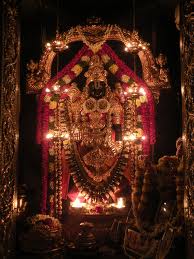
| Lord Parthasarathy |
Once, a
British tax collector was surprised to see Lord Parthasarathy at Triplicane
being fanned during an utsavam. He asked the Bhattacharyar if the Lord would
sweat if they stopped fanning Him. The Bhattacharyar replied without any doubt
that the Lord would definitely sweat. The tax collector ordered them to stop
fanning the Lord. He came near the Lord and to his surprise saw drops of sweat
on the Lord’s forehead. Lord Parthasarathy always makes sure that His devotees’
words come true. To this day He can be seen sporting the scars from the
Mahabharata war caused by the arrows of Bhishmacharyar with pride.

Bhishmacharyar thought with fondness about Lord Parthasarathy
who per the request of Arjuna stopped the chariot between the two troops and
allowed Arjuna to have one look at the Kauravas. Arjunan did not see his
enemies but only his family amongst the Kauravas for, on purpose the Lord had
positioned the chariot in such a way that Arjunan’s gaze fell upon
Bhishmacharyar and Dronacharyar. When Arjunan refused to fight against his dear
grandfather and Acharyan, the Lord preached karma Yoga and caused Arjunan to
fight against Bhishmacharyar.
 |
| www.hinduhumanrights.info |

Bhishmacharyar thought about Lord Krishna with love
for making Bhishmacharyar’s vow come true while breaking His own vow.
‘Duryodana
and Arjuna approached Lord Krishna to seek His help in the upcoming war. Lord
Krishna knew that they would be arriving. He removed every single chair from
His bed chamber all except one throne placed behind His head board and a small
foot stool place near His foot board. Lord Krishna instructed His guards to
allow anyone inside His chamber while He slept. Lord Krishna then pretended to sleep
and Duryodana arrived first. As Duryodana entered the chamber He pitied himself
for having to seek the help of a Yadava. Feeling arrogant that he was superior
to even Lord Krishna, Duryodana occupied the throne behind His head board. Very
soon Arjuna entered. Arjuna did not notice Duryodana but as soon as he entered
he saw the Lord Krishna’s beautiful feet he stood humbly near the His
footboard. After making sure that Arjuna has arrived, Lord Krishna opened His
eyes and as His eyes first fell on Arjuna, He welcomed him. Duryodana
immediately objected stating that he had arrived before Arjuna. He replied that
as He had first seen Arjuna, He would first offer the choice to Arjuna.

Lord
Krishna asked Arjuna to choose between His strong military consisting of 9
crore units on one side and Him. Lord Krishna informed Arjuna that He will not
fight in the war. To Duryodana’s delight, Arjuna chose Lord Krishna over His
military units. Duryodana went back to Hastinapuram and informed Bhishmacharya.
Bhishmacharya sent Duryodana back to Dwaraka asking Lord Krishna to promise
that He will not touch any weapons during the war. Lord Krishna solemnly vowed
to never touch a weapon.
Once, the
war started Duryodana was sorry to see his side suffer severely while the Pandava
army remained unaffected. He blamed Bhishmacharyar of being partial and not
fighting with the intent of destroying the Pandavas.
‘I will
make this world bereft of Pandavas before Sunset tomorrow as long as I don’t
face any hurdles in battle!’ vowed Bhishmacharyar.
Draupadi
came to hear about this vow and she rushed to Lord Krishna for help.
‘Grandfather
always fulfills his vows. I am afraid for my husbands!’
‘I am
concerned as well,’ said Lord Krishna.
‘I came
to you because you might have a way out but am now really worried if you are
concerned!’
‘Don’t
worry. There is a way. I will take you to meet my devotee. As soon as you see
him, you must fall at his feet without speaking a word. If he blesses that your
husbands will live a long life, it will definitely come true.’
The Lord
escorted Draupadi through the battle field till they came outside a tent. He
signalled to draupadi to enter the tent. Draupadi saw an old man sharpening his
arrow heads upon entering the tent. She did not see his face clearly but per
Lord’s instruction she fell at the old man’s feet.
The old
man saw a woman fall at his feet. ‘Raise my child, may you never be widowed!’
From the
voice Draupadi recogonized the old man as Bhishmacharyar.
‘Did you
raelly bless me or was it just something you uttered in passing?’
‘My words
always come true! Who are you? Get up?’
As
Draupadi got up, Bhishmacharyar was surprised to see her.
‘I have
been tricked but I am sure it is not your fault my child!’ he said as he felt
sorry that Draupadi had endured great sufferings in the past 13 years of her
life. ‘This must be Bhima’s idea!’ he said as he stepped outside the tent to
argue with Bhima.
Bhishmacharyar
was surprised to see lord Krishna.
‘Draupadi
our job is done let us go!’ called the Lord.
‘You cannot
trick me!’ said Bhishmacharyar. ‘My earlier vow to rid the Pandavas superceded
this vow since I had made that vow after considering all facts!’
‘I agree
with you,’ said the Lord. ‘So a vow made even earlier to the one made yesterday
after taking into consideration all the facts should supercede yesterday’s vow.
Plus, you said that if you don’t face any hurdles in battle you will rid the
Pandavas. I plan on causing hurdles for you by bringing Shikandi. According to
your earlier vow made many years ago you will not use your weapons in the
presence of Shikandi!’
Bhishmacharyar
felt very happy that the Lord planned to use Shikandi to save the Pandavas but
he pretended to be angry. ‘If you break my vow, I will make you break your vow
by making you take up weapon on the battle field! If I am not unable to do so,
then I am not the Son of Ganga nor would I have practised the vow of celibacy
properly!’ Bhishmacharyar secretly wished to have darshan of the Lord with
Sudarsana Chakram in His hand.
‘So be
it!’ said Lord Krishna and left with Draupadi.
As
Bhishmacharya was His dear devotee, Lord Krishna wanted to make his wish come
true. Every day in the morning Bhishmacharya performed archanai to worship the
lord and then came to the battle filed. He showered arrows on Lord Krishna
considering the attack to be the archanai performed as part of Karma Yoga to
worship Him. Lord Krishna was very pleased with Bhishmacharya but upset that
Arjuna wasn’t fighting back Bhishmacharya. Arjuna didn’t have the heart to
attack Bhishmacharya. Hence, pretending to be angry, Lord Krishna jumped down
from the chariot and rushed towards Bhishmacharya. Even without being called,
Sudarsana Chakram took its place on His finger. Thus Lord Krishna broke His own
vow to fulfill the wish of Bhishmacharya. Bhishmacharya wanted to see if Lord
Krishna would break His vow once more on the following day and Lord Krishna
kindly obliged by rushing towards Bhishmacharya once again with Sudarsana
Chakram in His hand.

The Lord
left His upper cloth on His chariot seat and rushed towards Bhishmacharyar. He
left the upper cloth so that noone will take His place on the chariot. He also
left His cloth to protect Arjuna while He was away and to keep the horses under
control.

Bhishmacharyar felt happy to see Lord Parthasarathy
once again at his death bed. None of the warriors who looked at the Lord could
fight during the war as they were mesmerized by His beauty. Even the soldiers
in the Kaurava Army were mesmerized by the Lord. Everyone who participated in
the war was blessed by the divine darshan. The fallen warriors thus attained
mukthi.
The gopis on the other hand first obtained the fruit
called “Lord Krishna” and then received spiritual knowledge from Him to perform
Bakthi Yogam. The Lord enjoyed the devotion showered upon Him by them without
realizing that He had granted them the ability to shower such love upon
Himself. This is equivalent to a child admiring his reflection in the mirror
without realizng that the reflection is there because he is standing in front
of the mirror. Such Is the supreme grace of the Lord that out of compassion He
accepts the devotion shown to Him by others as if they were doing so on their
own accord even though He was the one who had given them the ability to perform
devotional service.

All the sages and kings drank in the beauty of the
Lord at Yudhishtirar’s Rajasuya yagam and praised Him. Bhishmacharyar feels
pleased that this Lord is once again standing in front of him.

Bhishmacharyar understood the Lord as the cause of
everyone. He exists in the hearts of everyone and is experienced by many Yogis.
Even though He exists as many in each person’s heart He is one and the same
just like the way in which there is one Sun in the sky but the reflection is
seen in all water bodies. Having realized the Lord, Bhishmacharyar breathed his
last breath and attained the Lord’s divine feet.
 |
| Lord Parthasarathy - Thiruvellikeni Divya Desam |