The
ancient Babylonians cremated their dead. According to history textbooks, king
Nebuchadnezzar threatened to throw three Jews into a fiery furnace which
was kept burning at all times to cremate the dead.
There
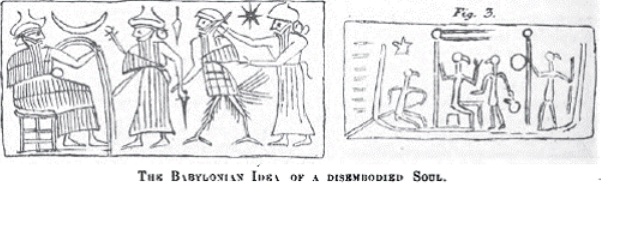
are some cylinder seals from Babylonia that depict a half man half bird being
brought before Minos for judgment. Minos is the Babylonian pronunciation for
Manu.
Soul
is compared to a bird in the Vedic texts. In the case of an enlightened being,
the bird represents flying away to higher region. A bird is also called
patanka in Sanskrit which is derived from the root “to fall” and represents the
fall of humans in to samsara.
The
Babylonians considered that all souls possess a semi bird like character after
death. This might have been derived from the Vedic concept that all souls
possess knowledge about self and paramatma but when inside a body, the inherent
knowledge is dimmed. The karma accumulated while residing in a body would pull
the soul down into samsara and prevent it from flying away. This might be why
the Babylonians depicted souls as half human and half bird like. The bird half
of the soul depicts the soul’s inherent knowledge while the human half of the
soul represents the accumulated karma.
References:
The
Arian Witness by Rev. K.M. Banerjea
The
origin of Pagan idolatry by George Stanley Faber


No comments:
Post a Comment
Note: only a member of this blog may post a comment.